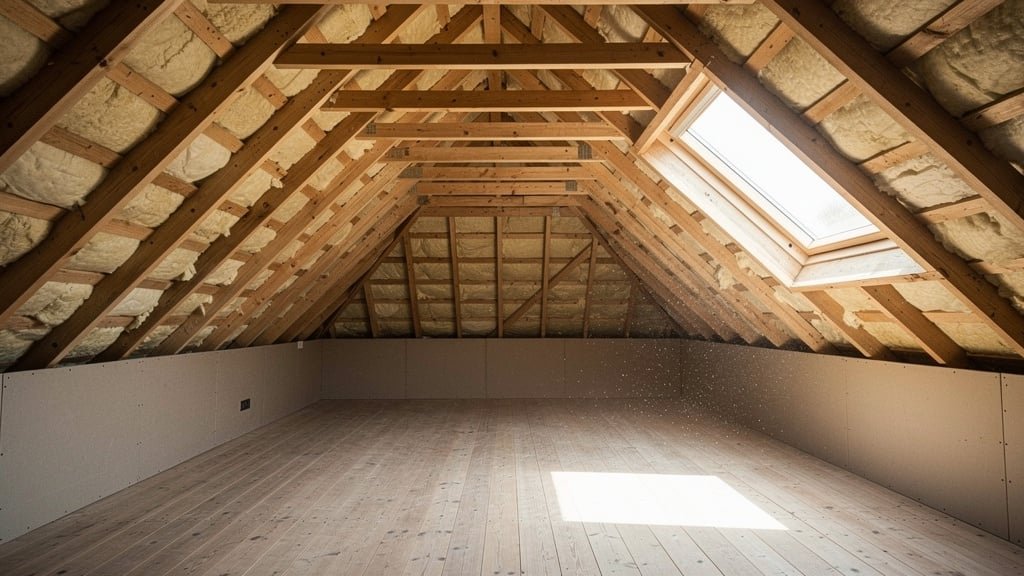
Poor roof insulation costs UK homeowners hundreds of pounds annually in wasted energy, with approximately 25% of home heat loss occurring through inadequately insulated roofs. My Roof Surveyor UK incorporates insulation assessment into comprehensive roof surveys, identifying deficiencies that increase heating costs and providing practical recommendations for improvements that deliver rapid payback through reduced energy bills.
This expert guide explains how roof surveys evaluate insulation performance, what problems surveyors commonly identify, current building regulations standards, and practical improvement strategies that balance energy efficiency with roof health and property requirements.
Understanding Roof Insulation and Heat Loss
Warm air rises, making roofs the primary escape route for home heating unless properly insulated.
How Heat Escapes Through Roofs:
- Conduction: Heat transfers through materials from warm to cold areas
- Convection: Warm air moves through gaps and spaces
- Radiation: Heat radiates from warm surfaces to cold surfaces
- Air leakage: Warm air escapes through gaps around penetrations and edges
Proper insulation addresses all these mechanisms, creating a thermal barrier that keeps heat inside living spaces during winter and prevents excessive solar gain during summer.
Current UK Insulation Standards
Building regulations specify minimum insulation levels, though these have increased substantially over decades.
Current Building Regulations (2024):
- New builds: Minimum 270mm of mineral wool insulation (or equivalent U-value 0.16 W/m²K)
- Renovations/improvements: Aim for 270mm where practical, minimum 100mm acceptable in constraints
- Loft conversions: 100-150mm between rafters plus insulated plasterboard
- Flat roofs: 150-200mm depending on construction type
Historical Standards:
- Pre-1970s: Often no insulation or minimal 25mm
- 1970s-1990s: 100mm became standard
- 1990s-2000s: Increased to 150-200mm
- 2000s-2010s: 250mm became common
- Current standard: 270mm+ for optimal performance
Properties built or last insulated before 2000 likely have inadequate insulation by modern standards.
How Professional Surveys Assess Insulation
Comprehensive roof surveys evaluate multiple insulation aspects beyond simple depth measurement.
Visual Loft Inspection:
Insulation depth and coverage:
- Measuring actual insulation thickness throughout loft space
- Identifying areas with insufficient, missing, or compressed insulation
- Checking coverage around eaves, party walls, and difficult areas
- Verifying insulation hasn't been disturbed by contractors or storage
- Assessing condition—wet, compressed, or degraded insulation loses effectiveness
A Birmingham semi-detached had been insulated to 100mm in 1985. When we surveyed in 2023, the insulation had compressed to approximately 70mm and been disturbed in several areas for electrical work. Effective insulation depth averaged only 60mm—far below current standards and explaining the owner's high heating costs.
Insulation material identification:
- Mineral wool (most common, good performance)
- Fibreglass (similar to mineral wool)
- Foam boards (higher R-value per inch)
- Natural materials (sheep's wool, cellulose)
- Older materials potentially containing hazardous substances
Thermal Imaging Assessment:
Thermal cameras reveal insulation deficiencies invisible to visual inspection:
- Cold spots: Areas with missing or inadequate insulation showing temperature drops
- Thermal bridging: Structural elements conducting heat through insulation layer
- Air leakage paths: Gaps allowing warm air to escape to loft space
- Compression zones: Areas where insulation has been flattened, reducing effectiveness
- Moisture problems: Wet insulation showing different thermal signature
Thermal surveys are particularly valuable because they identify problems that wouldn't be apparent even during loft inspection—for example, insulation that looks adequate but has moisture problems reducing its thermal performance by 50% or more.
Ventilation Assessment:
Proper ventilation is crucial—insulation without adequate ventilation causes condensation and rot:
- Verifying soffit vents aren't blocked by insulation
- Checking ridge or tile ventilation provides adequate air circulation
- Ensuring ventilation paths from eaves to ridge remain clear
- Assessing whether insulation installation has compromised ventilation
- Identifying condensation problems from inadequate ventilation
Common Insulation Problems Identified
Professional surveys reveal recurring insulation issues affecting energy performance.
1. Insufficient Depth
Most common problem—insulation installed to older standards:
- Properties with 100mm insulation losing twice the heat of properly insulated homes
- Simple solution: adding additional insulation layer on top of existing
- Typically 100-150mm additional needed to reach current standards
- Cost: £300-600 for DIY, £600-1,200 professional installation
- Payback period: typically 2-4 years through reduced heating bills
2. Missing Coverage in Key Areas
Gaps in insulation coverage create disproportionate heat loss:
Common problem areas:
- Eaves: Difficult to insulate properly, often left incomplete
- Loft hatches: Frequently uninsulated or poorly sealed
- Party walls: Shared walls between properties often neglected
- Around penetrations: Gaps left around pipes, cables, chimneys
- Dormer cheeks: Vertical sections often inadequately insulated
A Leeds terrace had good insulation coverage generally but completely uninsulated eaves and party walls. Thermal imaging revealed these 15% of the roof area accounted for approximately 40% of total roof heat loss—disproportionate impact from relatively small gaps.
3. Compressed or Disturbed Insulation
Insulation effectiveness depends on maintaining its loft—compression dramatically reduces performance:
- Insulation compressed by storage items loses 50-70% of effectiveness
- Boards laid over insulation compress it significantly
- Contractors working in lofts often disturb insulation without replacing it properly
- Rodent activity can move and compress insulation
4. Moisture-Damaged Insulation
Wet insulation loses thermal performance catastrophically:
- Roof leaks saturating insulation
- Condensation from inadequate ventilation
- Moisture from bathrooms reaching loft space
- Wet insulation must be removed and replaced—cannot dry effectively in situ
5. Blocked Ventilation
Overzealous insulation installation blocking essential ventilation:
- Insulation pushed into eaves blocking soffit vents
- No air gap maintained between insulation and roof covering
- Results in condensation, dampness, and timber rot
- The "improvement" causes expensive structural damage
A Manchester Victorian terrace had been professionally insulated but installers pushed mineral wool into eaves, blocking all soffit ventilation. Within two years, condensation caused timber rot requiring £7,000 in repairs—the insulation improvement caused more expense than it saved.
Insulation Improvement Strategies
Surveys provide prioritized recommendations balancing cost, effectiveness, and practical constraints.
Quick Wins—High Impact, Low Cost:
1. Loft Hatch Insulation
- Cost: £20-50 DIY
- Impact: Eliminates major heat loss point
- Method: Insulated board attached to hatch, draft seal around frame
2. Additional Insulation Layer
- Cost: £300-600 DIY for average semi-detached
- Impact: Can reduce roof heat loss by 30-50%
- Method: Additional 100-170mm layer at right angles to existing insulation
- Payback: Typically 2-4 years through reduced heating bills
3. Filling Insulation Gaps
- Cost: £100-300 DIY depending on extent
- Impact: Disproportionately large given small areas addressed
- Method: Insulate party walls, eaves, around penetrations
Moderate Investment—Comprehensive Improvements:
Professional Insulation Upgrade
- Cost: £800-1,500 for complete loft insulation to current standards
- Impact: Reduces roof heat loss by 50-70%
- Includes: Proper ventilation maintenance, comprehensive coverage, professional installation
- Typical savings: £300-600 annually on heating bills
- Payback: 2-4 years, then ongoing savings
Specialized Situations:
Loft Conversions and Room-in-Roof
- Requires between-rafter insulation plus insulated plasterboard
- More complex and expensive than loft floor insulation
- Must maintain ventilation air gap
- Professional installation essential
- Cost: £2,000-5,000 depending on size and complexity
Flat Roof Insulation
- Often requires complete roof reconstruction to add adequate insulation
- Can't usually be improved without major works
- Plan insulation improvements when roof needs recovering anyway
- Modern flat roof construction includes substantial insulation
Balancing Insulation with Roof Health
Insulation improvements must consider roof ventilation and moisture management.
Critical Principles:
Maintain Adequate Ventilation:
- Never block soffit vents with insulation
- Maintain air circulation paths from eaves to ridge
- Consider adding ventilation if increasing insulation significantly
- Balance insulation with ventilation—both are essential
Address Moisture Sources:
- Ensure bathrooms vent outside, not into loft space
- Fix roof leaks before adding insulation
- Install vapor barriers in appropriate locations
- Never insulate over wet or damaged materials
Use Appropriate Materials:
- Breathable insulation for traditional construction
- Moisture-resistant materials for at-risk locations
- Consider future access requirements
Energy Performance Certificates and Insulation
Roof insulation significantly impacts property Energy Performance Certificate (EPC) ratings.
EPC Impact:
- Inadequate insulation drops EPC rating significantly
- Upgrading to 270mm can improve rating by 1-2 bands
- Higher EPC ratings increase property value and marketability
- Some buyers filter property searches by minimum EPC rating
- Future regulations may require minimum EPC ratings for sales and rentals
Key Takeaways
- Approximately 25% of home heat loss occurs through inadequately insulated roofs
- Current standard is 270mm insulation—most pre-2000 properties have insufficient depth
- Thermal imaging reveals insulation problems invisible to visual inspection
- Adding insulation to 270mm typically pays for itself within 2-4 years
- Ventilation must be maintained—never block soffit vents with insulation
- Wet insulation must be replaced—cannot dry effectively in situ
- Small gaps (loft hatches, party walls) create disproportionate heat loss
- Professional surveys identify specific improvements with best cost-benefit ratios
Frequently Asked Questions
Current building regulations recommend 270mm of mineral wool insulation (or equivalent thermal performance). Most UK properties built before 2000 have insufficient insulation by modern standards—typically 100-150mm. If you can see the top of your ceiling joists, you need more insulation. Adding 100-170mm additional layer on top of existing insulation brings most properties to current standards for £300-600 DIY or £600-1,200 professionally installed.
Adding additional insulation layer is suitable for confident DIYers. Purchase insulation rolls from builders merchants, lay them perpendicular to existing insulation, ensuring you don't block eaves ventilation or compress existing insulation. However, hire professionals if: your loft has complex layout, you're uncertain about ventilation requirements, existing insulation needs removing/replacing, or you're insulating loft conversion/room-in-roof. Professional installation ensures proper ventilation maintenance and comprehensive coverage.
Yes, typically within 2-4 years. Upgrading from 100mm to 270mm insulation reduces roof heat loss by 40-60%, saving £300-600 annually on heating bills for average UK homes. Investment of £300-1,200 (depending on DIY vs professional) pays for itself quickly, then provides ongoing savings for decades. Additionally, improved insulation increases property value, improves EPC rating, and enhances comfort. It's one of the best value home improvements available.
No, 100mm was the standard in the 1970s-1990s but is insufficient by modern standards. Properties with 100mm insulation lose approximately twice as much heat through roofs compared to properties with current 270mm standard. Adding 170mm additional layer brings you to current standards and typically saves £300-500 annually on heating bills. The improvement is straightforward—simply add additional insulation layer on top of existing at right angles to it.
This is critical concern. Never block soffit vents with insulation—this causes condensation and timber rot. When adding insulation, maintain clear air paths at eaves using proprietary vent trays or by keeping insulation back from eaves edges. Loft spaces need ventilation despite insulation to prevent condensation buildup. Professional surveys assess whether existing ventilation is adequate or if additional ventilation is needed when upgrading insulation. Balance is key—both insulation and ventilation are essential for roof health.
Professional Insulation Assessment
My Roof Surveyor UK incorporates comprehensive insulation assessment into roof surveys, using visual inspection and thermal imaging to identify deficiencies and improvement opportunities. Our surveys provide specific recommendations with cost-benefit analysis, helping you prioritize improvements for maximum energy savings and comfort enhancement.
Whether you're experiencing high heating costs, conducting pre-purchase assessment, or planning energy efficiency improvements, our surveys deliver actionable insights for reducing energy waste through improved roof insulation.