Adequate roof ventilation is one of the most misunderstood yet critical aspects of roof health—My Roof Surveyor UK encounters countless properties where inadequate ventilation has caused thousands of pounds in condensation damage, timber rot, and insulation deterioration that could have been prevented through proper airflow. While homeowners obsess over roof coverings, ventilation quietly determines whether moisture destroys structures from within or harmlessly escapes before causing problems.
This essential guide explains why roof ventilation matters so much, how professional surveys assess ventilation adequacy, recognizing ventilation problems, and implementing solutions that protect your property investment from moisture damage.
Understanding Roof Ventilation Principles
Effective ventilation manages moisture through controlled air circulation.
Why Ventilation is Essential:
- Moisture removal: Water vapor from living spaces rises into loft spaces requiring escape routes
- Condensation prevention: Airflow prevents warm moist air condensing on cold roof surfaces
- Temperature regulation: Summer heat dispersal and winter cold maintenance
- Timber preservation: Dry conditions prevent rot and fungal growth
- Insulation protection: Dry insulation maintains thermal performance
The UK Ventilation Challenge:
British climate creates ideal conditions for condensation problems:
- High humidity levels year-round
- Significant temperature differences between interior and exterior in winter
- Modern airtight construction trapping moisture indoors
- Lifestyle factors (cooking, bathing, drying clothes) creating substantial moisture
- Energy efficiency measures reducing accidental ventilation
A Cardiff property was refurbished with new windows and doors, dramatically improving airtightness. The owners were pleased with reduced drafts and heating bills—until condensation appeared in the loft. The improved airtightness had eliminated accidental ventilation that was previously managing moisture. Adding proper loft ventilation cost £450; repairing the condensation-caused timber rot cost £2,800.
Types of Roof Ventilation
Multiple ventilation systems work together providing comprehensive airflow.
Eaves Ventilation (Soffit Vents):
- Location: Continuous opening along eaves where roof meets walls
- Function: Provides air intake at lowest point of roof space
- Types: Purpose-made soffit vents, continuous strip vents, circular vents
- Size requirement: Equivalent to 10mm continuous gap along eaves length
Critical importance: Eaves ventilation provides the "intake" for roof space ventilation. Without it, other ventilation cannot function effectively.
Ridge Ventilation:
- Location: Along roof apex/peak
- Function: Allows warm moist air to escape at highest point
- Types: Continuous ridge vents, tile vents spaced along ridge, dry ridge systems
- Operation: Natural convection carries warm air upward and out
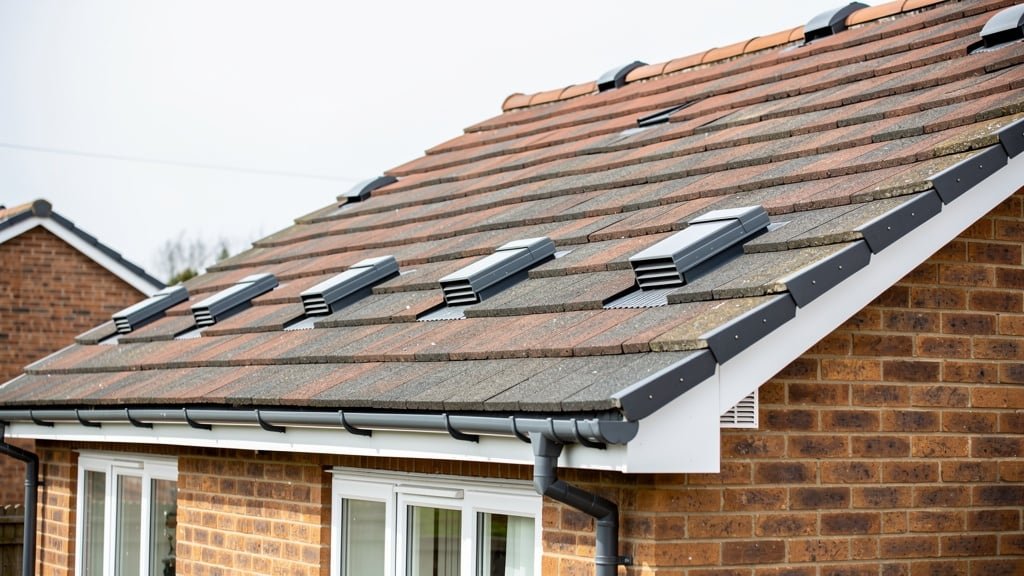
Tile Vents:
- Location: Replacing individual tiles at appropriate positions
- Function: Provides mid-height ventilation points
- Specification: Typically 2-4 vents per roof slope depending on area
- Placement: Positioned high on roof slope for effectiveness
Gable End Vents:
- Location: In gable walls at loft level
- Function: Cross-ventilation for properties without ridge access
- Types: Fixed louvered vents, mesh grilles
- Requirements: Need protection against weather penetration
How Professional Surveys Assess Ventilation
Comprehensive ventilation evaluation considers multiple factors.
Ventilation Adequacy Assessment:
Calculating requirements:
- Roof area determines minimum ventilation needed
- Building regulations require specific ventilation ratios
- Cold deck roofs (insulation at ceiling level): minimum 10mm equivalent continuous ventilation
- Warm deck roofs (insulation at rafter level): different requirements
Measuring existing ventilation:
- Counting and sizing all ventilation points
- Calculating total ventilation area provided
- Comparing against requirements for property size
- Identifying whether ventilation is adequate, marginal, or insufficient
Ventilation Effectiveness Evaluation:
- Airflow observation: Checking whether air actually circulates
- Moisture signs: Looking for condensation, dampness, mold in loft spaces
- Timber condition: Assessing whether timbers show moisture damage
- Insulation condition: Checking for moisture saturation
- Blockage identification: Finding obstructions preventing airflow
Common Ventilation Problems
Surveys identify recurring ventilation defects.
1. Blocked Soffit Vents
Most common and easily prevented problem:
- Insulation pushed into eaves blocking ventilation openings
- Overzealous insulation installation without maintaining air gaps
- Bird nests or wasp nests blocking vents
- Paint covering vent openings during repainting
Consequences: Blocks primary air intake, preventing entire ventilation system from functioning properly.
A Manchester property had loft insulation upgraded to 270mm for energy efficiency. Installers pushed insulation right to eaves, completely blocking soffit vents. Within 18 months, condensation caused visible mold growth on roof timbers and saturated insulation. Clearing the blockage cost £200; repairing condensation damage cost £3,400.
2. Insufficient Ventilation Provision
Properties not meeting building regulations requirements:
- Older properties built before current ventilation standards
- Extensions or loft conversions without adequate ventilation added
- Properties where insulation improved without ventilation upgrade
- Calculation errors during original construction
3. Unbalanced Ventilation
Inadequate intake or outlet creating poor circulation:
- Ridge ventilation without corresponding eaves intake
- Eaves vents without high-level exhaust points
- Ventilation on only one side of roof
- Creates stagnant air pockets where moisture accumulates
4. Ventilation Above Insulation
Between-rafter insulation without maintaining air gaps:
- Insulation filled completely between rafters touching roof deck
- No air circulation space above insulation
- Condensation forms on cold roof deck
- Particularly problematic in loft conversions and room-in-roof constructions
Signs of Ventilation Problems
Recognizing indicators that ventilation is inadequate.
Visible Signs:
- Condensation: Water droplets on roof timbers, nails, or underside of roof covering
- Mold growth: Black or green mold on timbers, particularly in corners
- Saturated insulation: Wet or damp insulation materials
- Timber staining: Dark stains or discoloration indicating moisture exposure
- Musty odors: Damp smell in loft spaces
- Frost: Ice formation inside loft during cold weather (indicates moisture)
Performance Issues:
- Excessive summer heat in loft spaces
- Higher than expected heating costs (wet insulation loses effectiveness)
- Interior condensation on windows
- Ceiling mold or staining below loft spaces
Solutions and Improvements
Addressing ventilation deficiencies protects property investment.
Adding Ventilation:
Soffit vent installation:
- Cost: £200-400 for average property
- Drilling circular vents or installing continuous strip vents
- Relatively straightforward retrofit
Ridge ventilation addition:
- Cost: £400-800 depending on roof length
- Installing continuous ridge vent or tile vents
- More involved but highly effective
Tile vent installation:
- Cost: £80-150 per vent including fitting
- Quick retrofit solution
- Typically 2-4 vents needed per roof slope
Clearing Blockages:
- Moving insulation away from soffit vents (DIY possible)
- Installing vent trays maintaining clear airflow paths
- Removing nests or debris blocking vents
- Usually costs £150-300 professionally
Balancing Systems:
- Ensuring adequate intake (soffit) and outlet (ridge/tile) ventilation
- Cross-ventilation for complex roof shapes
- Professional assessment identifies specific improvements needed
Ventilation and Modern Building Standards
Current regulations recognize ventilation's critical importance.
Building Regulations Requirements:
- Minimum 10mm equivalent continuous ventilation for cold deck roofs
- Cross-ventilation requirements for roofs over 10m span
- Specific requirements for warm deck and room-in-roof constructions
- Higher ventilation rates for certain roof configurations
Balancing Ventilation and Insulation:
Modern energy efficiency requirements create tension with ventilation needs:
- Higher insulation levels require more careful ventilation design
- Airtight construction traps more moisture requiring mechanical ventilation
- Warm deck systems move insulation upward, changing ventilation requirements
- Vapor barriers become more critical in highly insulated roofs
Key Takeaways
- Inadequate ventilation causes condensation, timber rot, and insulation deterioration
- Eaves (soffit) ventilation provides critical air intake—never block it
- Balanced ventilation requires both intake (eaves) and exhaust (ridge/tile) points
- Blocked soffit vents are the most common ventilation problem
- Improving insulation without upgrading ventilation creates moisture problems
- Professional surveys assess whether ventilation meets requirements
- Adding ventilation costs hundreds; repairing condensation damage costs thousands
- Regular loft inspections identify ventilation problems before serious damage occurs
Frequently Asked Questions
No—this is a common misconception. Loft ventilation circulates air in the cold loft space above insulation, not in heated living areas. Proper insulation at ceiling level creates thermal barrier separating warm living spaces from cold ventilated loft. In fact, inadequate ventilation causes condensation that saturates insulation, reducing its effectiveness and increasing heating costs. Well-ventilated dry insulation performs far better than poorly ventilated wet insulation. Ventilation and insulation work together, not against each other.
Loft condensation requires immediate attention before causing structural damage. First, check whether soffit vents are blocked—this is most common cause. Second, assess whether ventilation is adequate for loft size. Third, identify moisture sources (bathroom steam, drying clothes indoors, cooking without extraction). Solutions include: clearing blocked vents, adding ventilation if insufficient, improving extraction of moisture sources, installing vapor barriers if needed. Professional survey identifies specific problems and recommends targeted solutions. Don't ignore condensation—it progressively worsens causing expensive timber rot.
Signs of adequate ventilation: dry loft space, no condensation on roof timbers, no musty odors, dry insulation, and no mold growth. Signs of inadequate ventilation: condensation, mold, damp insulation, timber staining, or musty smells. Professional surveys calculate whether ventilation meets building regulations for your roof area and assess whether existing ventilation functions effectively. This assessment costs £300-500 as part of comprehensive roof survey—minimal investment compared to £2,000-£5,000+ condensation damage repair costs.
Critical: Never block soffit vents with insulation. Maintain 50mm clear air gap at eaves using vent trays or keeping insulation back from edges. Adding insulation without maintaining/improving ventilation causes condensation problems. If upgrading from 100mm to 270mm insulation, assess whether existing ventilation remains adequate—may need additional ridge or tile vents. Consider professional survey before insulation upgrades ensuring ventilation strategy appropriate for increased insulation levels. Proper ventilation costs £300-600 extra but prevents £3,000-£8,000 condensation damage from inadequate airflow.
Excessive ventilation is rare in UK but possible. Concerns include: wind-driven rain penetration through oversized vents, heat loss if insulation inadequate, and drafts in living spaces if ceiling not properly sealed. However, most UK properties have insufficient rather than excessive ventilation. Building regulations specify maximum as well as minimum ventilation levels. Professional assessment ensures ventilation is adequate without being excessive—balancing moisture management, energy efficiency, and weather protection appropriately for your specific property and climate conditions.
Professional Ventilation Assessment
My Roof Surveyor UK includes comprehensive ventilation evaluation in roof surveys, assessing adequacy, identifying blockages, and recommending improvements that prevent moisture damage while maintaining energy efficiency. Our surveys calculate whether existing ventilation meets building regulations, identify deficiencies, and provide specific upgrade recommendations with realistic cost estimates.
Whether you're experiencing condensation problems, planning insulation upgrades, or conducting routine property maintenance, our ventilation assessments deliver essential guidance for protecting your roof structure and preventing expensive moisture-related damage.